Brainly
Brainly is an AI-powered content bookmarking platform that helps users save, organize, search, and share content from YouTube, X (Twitter), articles, and other sources.
Unlike traditional bookmarking applications, Brainly uses semantic search powered by vector embeddings, allowing users to retrieve content based on meaning rather than exact keywords.
The application is built on Cloudflare's edge platform using an event-driven architecture. Content enrichment (metadata extraction and embedding generation) is performed asynchronously through Cloudflare Queues, keeping API responses fast and scalable.
Features
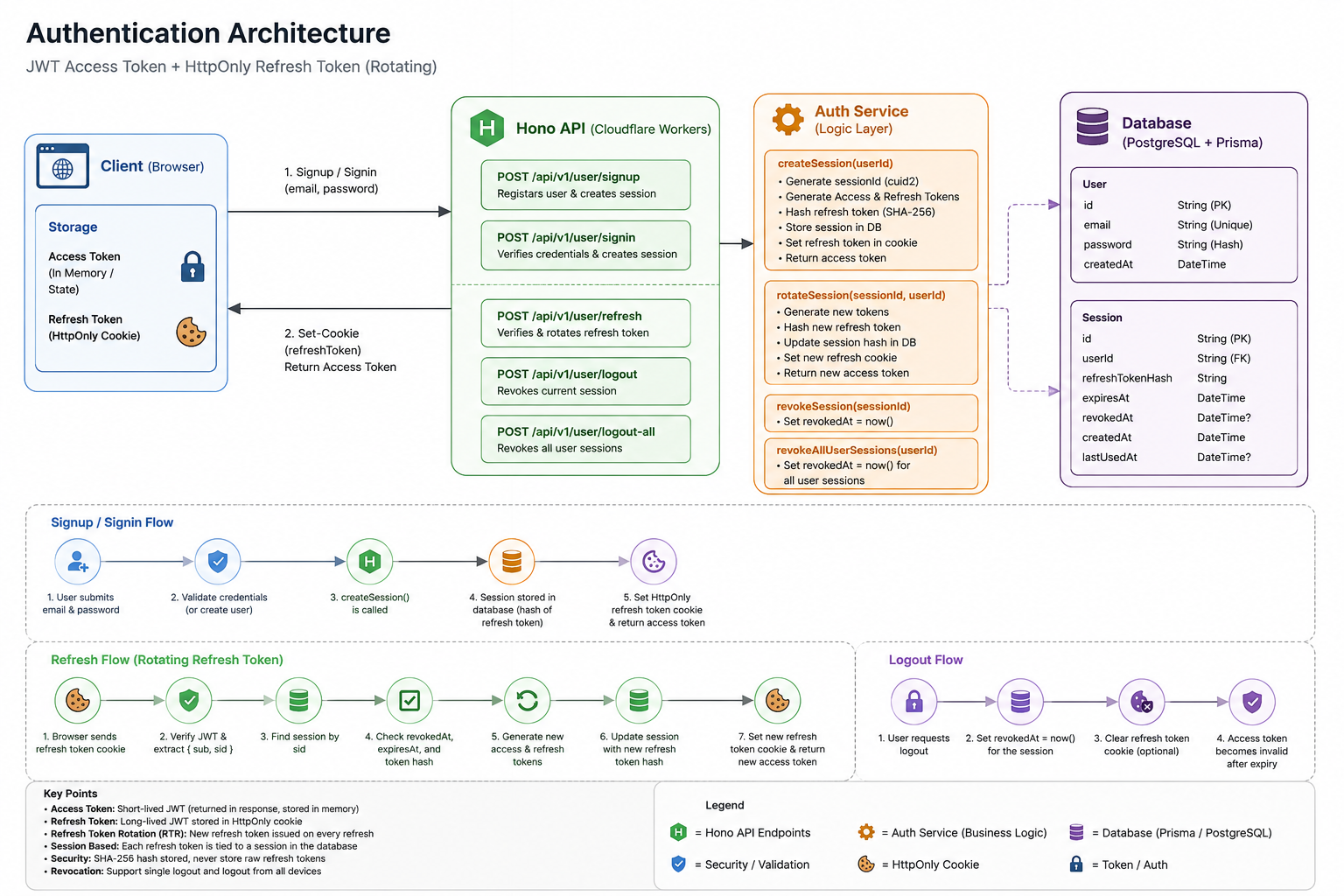
- JWT Authentication
- Save content from YouTube, X (Twitter), articles, and documents
- AI-powered semantic search using vector embeddings
- Automatic metadata extraction
- Tag-based organization
- Public shareable collections
- Background content processing
- Retry failed processing jobs
- Fast vector similarity search with pgvector
- Event-driven architecture using Cloudflare Queues
Tech Stack
Frontend
- React + Vite
- TypeScript
- TanStack Query
- Tailwind CSS
- shadcn/ui
- Lucide React
Backend
- Hono
- Cloudflare Workers
- Cloudflare Queues
- Cloudflare Workers AI
- Prisma ORM
- Prisma Accelerate
- PostgreSQL (Neon)
- pgvector
- Zod
- jose (JWT Authentication)
Infrastructure
- Turborepo
- Bun
- Wrangler
Architecture
                           ┌────────────────────┐
                           │      Client        │
                           └─────────┬──────────┘
                                     │
                                     ▼
                        ┌────────────────────────┐
                        │ API Worker (Hono)      │
                        │                        │
                        │ • Authentication       │
                        │ • CRUD                 │
                        │ • Semantic Search      │
                        │ • Queue Publisher      │
                        └─────────┬──────────────┘
                                  │
                                  │ Queue.send(contentId)
                                  ▼
                      ┌──────────────────────────┐
                      │  Cloudflare Queue        │
                      └──────────┬───────────────┘
                                 │
                                 ▼
                    ┌────────────────────────────┐
                    │ Processor Worker (Hono)    │
                    │                            │
                    │ • Consume Queue            │
                    │ • Fetch Metadata           │
                    │ • Generate Embeddings      │
                    │ • Update Database          │
                    │ • Retry Failed Jobs        │
                    └──────────┬─────────────────┘
                               │
              ┌────────────────┴──────────────┐
              ▼                               ▼
      Cloudflare Workers AI          Metadata Providers
             │                     (OpenGraph, YouTube)
             └──────────────┬──────────────────────────┘
                            ▼
                   PostgreSQL + pgvector
Authentication Architecture
Rate Limiting
Brainly uses Cloudflare Durable Objects to implement distributed, edge-native rate limiting for authentication and API endpoints.
Instead of relying on Redis or another centralized datastore, each client (identified by an IP address or user ID) is deterministically mapped to a dedicated Durable Object instance using idFromName(). Each Durable Object maintains its own request history and time window, enabling atomic updates and consistent rate limiting across Cloudflare's global edge network.
The algorithm is a sliding window: each object stores the requests it has seen bucketed per second (Record<epochSecond, count>), and on every request it sums the buckets inside the trailing window, discards the ones that just fell out, and allows the request only if there is room. Because the window advances one second per request rather than resetting on a fixed boundary, a client cannot spend its whole budget twice by straddling a boundary — the failure mode of a fixed window counter.
Durable Objects are single threaded and handle one request at a time per object, so the read-sum-write is already atomic and needs no locking.
This approach provides:
- Edge-native request limiting with low latency
- Accurate limiting with no fixed-window boundary burst
- Atomic request counting without race conditions
- No external infrastructure (Redis) required
- Independent rate limits per client
- Horizontally scalable architecture
X-RateLimit-Limit,X-RateLimit-Remaining,X-RateLimit-ResetandRetry-Afterresponse headers
Incoming Request
        │
        ▼
Rate Limit Middleware
        │
        Extract Client Key
        (IP / User ID)
        │
        ▼
idFromName(clientKey)
        │
        ▼
Durable Object
        │
        Read Buckets
        │
        Sum Buckets In
        Trailing Window
        │
        Prune Expired
        │
        Under Limit?
     ┌─────┴─────┐
     │           │
    No          Yes
     │           │
     ▼           ▼
 Register     Continue
 Request
The decision logic lives in apps/api/src/lib/sliding-window.ts as a pure function so it can be unit tested without the Workers runtime.
Repository Structure
brainly_app/
│
├── apps/
│   ├── api/
│   ├── processor/
│   └── web/
│
├── packages/
│   ├── ai/
│   └── db/
│
├── turbo.json
└── package.json
Content Processing Pipeline
Creating Content
When a user saves content, the API immediately stores the basic information and publishes a background job.
Client
    │
    ▼
POST /brain
    │
    ▼
Insert Content
status = PROCESSING
    │
    ▼
Publish Queue Message
(contentId)
    │
    ▼
201 Created
Background Processing
The Processor Worker consumes queue messages and enriches the content asynchronously.
Cloudflare Queue
        │
        ▼
Processor Worker
        │
        ▼
Load Content
        │
        ▼
Fetch Metadata
        │
        ▼
Generate Embedding
        │
        ▼
Update Database
        │
        ▼
status = COMPLETED
Semantic Search
Search queries are converted into vector embeddings and compared against stored content using pgvector similarity search.
Search Query
      │
      ▼
Generate Query Embedding
      │
      ▼
Vector Similarity Search
      │
      ▼
Rank Results
      │
      ▼
Return Relevant Content
Retry Flow
If background processing fails, the content is marked as FAILED.
An administrator or automated system can trigger a retry.
FAILED
   │
POST /retry/:contentId
   │
   ▼
status = PROCESSING
   │
   ▼
Queue.send(contentId)
   │
   ▼
Processor Worker
Content Lifecycle
PROCESSING
      │
      ▼
Metadata + Embedding Generated
      │
      ▼
COMPLETED
      │
      └────────────► FAILED
                          │
                          ▼
                    Retry Processing
Why Asynchronous Processing?
Metadata extraction and AI embedding generation involve external services and can significantly increase request latency.
Instead of performing these operations during the API request, Brainly publishes a message to Cloudflare Queues and immediately responds to the client.
A dedicated Processor Worker enriches the content in the background, improving:
- Lower API latency
- Better scalability
- Fault tolerance
- Automatic retries
- Separation of concerns
Database Features
- PostgreSQL relational data model
- Prisma ORM with type-safe queries
- pgvector for vector storage
- Vector similarity search
- Many-to-many content tagging
- Shareable public collections
Getting Started
Prerequisites
- Bun
- Node.js 20+
- Wrangler CLI
- Neon PostgreSQL
- Cloudflare Account
- Workers AI Enabled
Installation
git clone https://github.com/devnick10/brainly_app.git

cd brainly_app

bun install
Environment Variables
API Worker
DATABASE_URL=
JWT_SECRET=
ACCESS_ORIGIN=
Processor Worker
DATABASE_URL=
Frontend
NEXT_PUBLIC_API_URL=
Development
Run all applications:
bun run dev
Or run individual apps:
bun turbo dev --filter=api
bun turbo dev --filter=processor
bun turbo dev --filter=web
Database
Generate Prisma Client
bunx prisma generate
Push Schema
bunx prisma db push
API Routes
| Method | Endpoint | Description |
| ------ | -------------------------- | ---------------------------------- |
| POST | /api/v1/user/signup | Create account |
| POST | /api/v1/user/signin | User login |
| GET | /api/v1/brain | List saved content |
| POST | /api/v1/brain | Save new content |
| DELETE | /api/v1/brain/:contentId | Delete content |
| GET | /api/v1/brain/search?q= | Semantic search |
| POST | /api/v1/brain/share | Create or remove public share link |
| GET | /api/v1/brain/:shareLink | View shared collection |
Processor
| Method | Endpoint | Description |
| ------ | ----------------------- | ----------------------- |
| POST | /api/retry/:contentId | Retry failed processing |
| GET | /api/health | Health check |
Future Improvements
- Hybrid Search (Semantic + Full Text Search)
- Dead Letter Queue
- Content recommendations
- AI-generated summaries
- Personalized ranking
- Batch embedding generation
- Observability & metrics
- Content deduplication
Key Learnings
- Event-driven architecture
- Cloudflare Workers
- Cloudflare Queues
- Workers AI
- Edge computing
- Semantic search
- PostgreSQL + pgvector
- Background job processing
- Monorepo architecture with Turborepo
Author
GitHub: https://github.com/devnick10